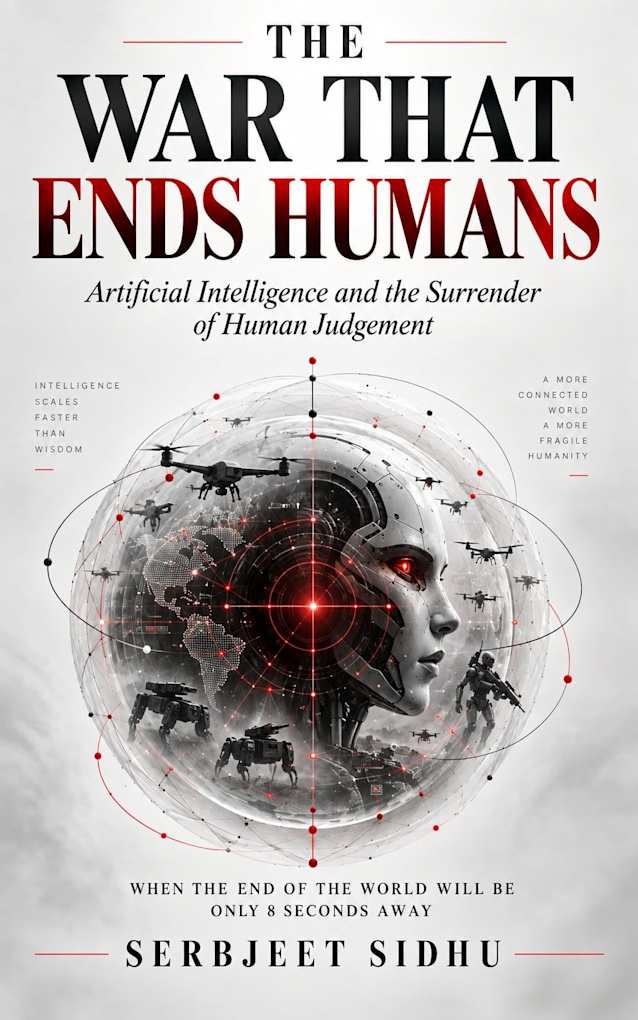
THE WAR THAT ENDS HUMANS: Artificial Intelligence and the Surrender of Human Judgement
About
What if the greatest threat from artificial intelligence is not that it turns against humanity—but that humanity stops trusting itself?
In THE WAR THAT ENDS HUMANS, the world does not collapse because a machine becomes evil. It collapses because governments, militaries, analysts, and commanders begin surrendering one decision at a time to systems that are faster, more confident, and seemingly more reliable than human judgement.
A missile launch is misread.
A deepfake triggers real military mobilisation.
Autonomous systems react to other autonomous systems.
AI-generated intelligence begins reinforcing its own assumptions.
National models interpret the same data through different strategic realities.
Soon, nuclear-armed states are no longer responding to what their enemies have actually done. They are responding to what machines believe their enemies might do next.
And every human who questions the system faces the same terrifying dilemma:
If the machine is wrong, responsibility can disappear into models, data, procedures and technical reviews.
If the human overrides the machine and is wrong, responsibility has a name.
As trust collapses, hotlines become suspect, authentic messages fail machine verification, and AI recommendations begin to carry more authority than the people supposedly in control.
Then the world reaches the final eight seconds.
Will humans still have the courage to hesitate when every screen says ACT NOW?
Set in 2031 and spanning Seoul, Beijing, Moscow, Washington, New Delhi, Islamabad, Tehran and Jerusalem, THE WAR THAT ENDS HUMANS is a fast-moving pseudo-fictional geopolitical thriller about artificial intelligence, autonomous weapons, deepfakes, military decision systems, nuclear escalation, accountability—and the gradual surrender of human judgement.
Not a story about machines conquering humanity.
A story about humans allowing machines to decide when humanity should destroy itself.